2005
SOUTH INDIA TOUR
6-30 January (25 days)
|
Forest Owlet Pretour 2 - 8 January (see below Costs and Conditions) |
India, one of the world's most exotic birding hotspots, is far
too large to cover on a single tour, so we offer several different tours to
allow comprehensive coverage of each of its faunal areas. On our South India
Tour, we'll see around 300 of the Indian Subcontinent's 1,300+ bird species,
including a good number of its 160± endemic species, many of which are
found only in southern India.
Winter is the prime time to visit southern India as the intense
heat of the other three seasons is moderated, it is the dryer season, and there
are more birds to be seen because of the presence of Palearctic migrants. Our
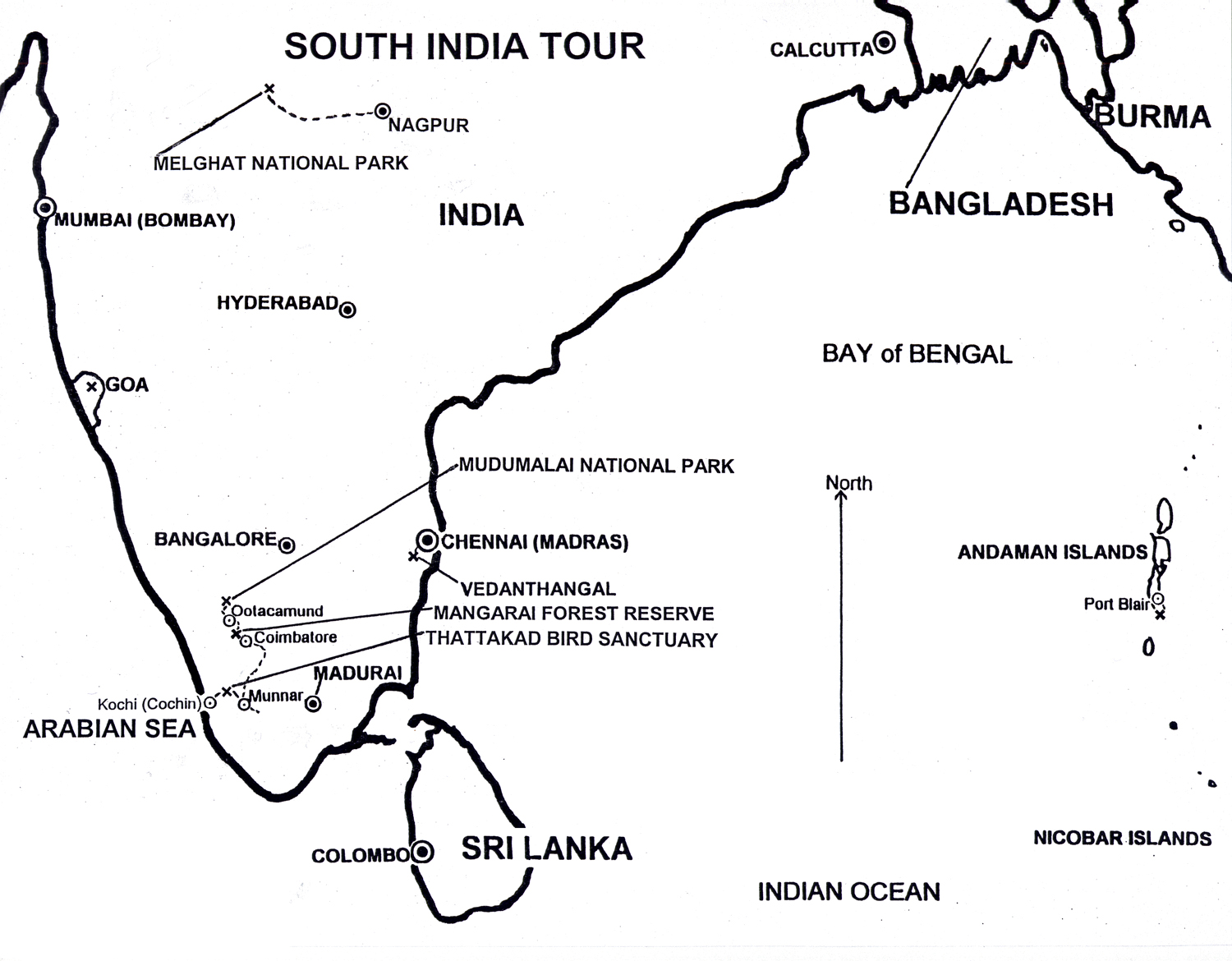
tour ranges from the beautiful lowland forests of Goa, to the submontane rain
forests and montane forests of the Western Ghats of S.W. India, the thorn scrub
of Tamil Nadu, and the tropical rain forests of the Andaman Islands.
Our concentration will be on finding the endemic birds of South
India and we'll find most of them, e.g.: Andaman Serpent-Eagle, Grey Junglefowl,
Andaman Cuckoo-Dove, Malabar Parakeet, Brown Coucal, Andaman Scops-Owl, Andaman
Boobook, Malabar Grey Hornbill, White cheeked and Crimson-throated Barbets,
Andaman Woodpecker, Jerdon's Bushlark, Nilgiri Pipit, Grey-headed and Yellow-throated
Bulbuls, White-bellied Shortwing, Rufous Babbler, Wynaad, Grey-breasted and
Rufous-breasted Laughingthrushes, Black-and-rufous, Nilgiri, and White bellied
Flycatchers, Crimson-backed Sunbird, White-headed Starling, Andaman Drongo,
and White-bellied Treepie. With luck, we may also see: Painted Bush-Quail, Red
Spurfowl and Nilgiri and Andaman Wood-Pigeons. We'll see many other species,
perhaps including Black Baza, Changeable, Crested and Mountain Hawk-Eagles,
Painted Spurfowl, Chestnut-winged and Pied Cuckoos, Grey-bellied Cuckoo, Violet
Cuckoo, Blue-faced Malkoha, Oriental Scops-Owl, Jungle Owlet, Ceylon Frogmouth,
Jerdon's and Indian Nightjars, Asian Paradise-Flycatcher, etc.
The tour involves some long, tiring drives. Much of the habitat
in southern India has been destroyed by the press of its many millions of people,
eliminating most birding near cities with airports. Accommodation is modest
to good. The food will range from basic sustenance to tasty. Anyone in good
health could manage the tour. It does not involve strenuous walking. Bird walks
are normally slow and easy. Join us for a grand birding adventure.
THE LEADER
BEN KING, president of KingBird Tours, has led 44 tours to
the Indian Region and is one of the most experienced bird-tour leaders on the
Subcontinent, having spent nearly 3 years birding there. He has published A
Field Guide to the Birds of South-East Asia and Checklist of
the Birds of Eurasia, and has seen 2,063 species of birds in Asia,
including all but 18 of the 1,333 species known to occur in the Indian Subcontinent.
His knowledge of the birds, their habits and where they are found assures you
of the best possible birding experience in the Indian Region.
THE BIRDING SITES
GOA (8-11 January) is a lovely tropical paradise situated on
the Arabian Sea. Its miles of beautiful beaches give way inland to paddyfields
and farther on to some fine forested areas. Our birding in Goa will center mostly
in the forests in search of Western Reef-Egret, White-bellied Sea Eagle, Crested
Serpent-Eagle, Crested Goshawk, Shikra, Besra, Black Eagle, Mountain Hawk Eagle,
Pompadour Pigeon, Vernal Hanging-Parrot, Plum-headed Parakeet, Oriental and
Indian Scops-Owls, Spot-bellied Eagle-Owl, Brown Fish-Owl, Brown Boobook, Ceylon
Frogmouth, Grey and Jerdon's Nightjars, Indian Swiftlet, White-rumped Needletail,
Alpine Swift, Crested Treeswift, Malabar Trogon, Blue-eared Kingfisher, Chestnut-headed
Bee-eater, Malabar Pied Hornbill, Brown-headed, White-cheeked and Crimson-throated
Barbets, Speckled Piculet, Brown-capped, Yellow-crowned, Rufous, and Heart-spotted
Woodpeckers, Black-rumped Flameback, Indian Pitta, Malabar Lark, Forest Wagtail,
Large Woodshrike, Grey-headed and Yellow-browed Bulbuls, Asian Fairy-bluebird,
Blue-capped Rockthrush, Malabar Whistlingthrush, Orange-headed Thrush, Puff-throated
and Dark-fronted Babblers, Brown-cheeked Fulvetta, Greenish, Bright-green and
Western Crowned Warblers, Brown-breasted, Red-throated, White-bellied, and Tickell's
Blue Flycatchers, Asian Paradise-Flycatcher, Thick-billed and Pale-billed Flowerpeckers,
Crimson backed Sunbird, Black-throated Munia, Chestnut-shouldered Petronia and
Eurasian Golden Oriole. Accommodation 2 nights in a pleasant tented camp, and
1 night in a nice basic hotel.
PERIYAR NATIONAL PARK (11-15 January) is one
of India's finest parks and birding localities. It's situated at about 900 meters
(3,000 ft.) and has some fine patches of primary evergreen forest. Some of the
many fascinating birds we're likely to see are: Wooly-necked Stork, Grey-Junglefowl,
Mountain Imperial Pigeon, Malabar Parakeet, Common Hawk-Cuckoo, Jungle Owlet,
Great Eared Nightjar, Brown-backed Needletail, Malabar Grey and Great Hornbills,
White bellied Woodpecker, Common and Greater Flamebacks, Indian Blue Robin,
Indian Scimitar Babbler, Rufous Babbler, Blyth's Reed-Warbler, Thick-billed
Warbler, Rusty-tailed Flycatcher, Black-lored Tit, Jungle Myna and White-bellied
Treepie. With luck, we might find a Black Baza, Rufous-bellied Eagle, Red Spurfowl,
Chestnut-winged Cuckoo, or Wynaad Laughingthrush. There is a good chance of
seeing an Indian Elephant here, as well as Gaur and Wild Boar. Accommodation
basic but comfortable.
The MUNNAR (15-17 January) area is perched high
in the Western Ghats in Kerala. There are nice patches of forest (sholas) left
amidst the grass, grazing land and cultivation, where we'll look for the local
endemics and other birds: Nilgiri Wood-Pigeon, Pacific Swallow, Nilgiri Pipit,
Black Bulbul, White-bellied Shortwing, Grey-breasted Laughingthrush, Large-billed
Leaf-Warbler, Black-and-rufous and Nilgiri Flycatchers, and Common Rosefinch.
We may see the endangered Nilgiri Tahr. Accommodation comfortable.
The SIRUVANI FOREST RESERVE or the MANGARAI
FOREST RESERVE near Coimbatore (18 January) will give us an opportunity
to see Oriental Honey-Kite, Short-toed Eagle, Indian Peafowl, Blue-faced Malkoha,
White-browed Wagtail, Black-headed Cuckooshrike, White-browed Bulbul, Nilgiri
Blackbird, Tawny-bellied Babbler, Yellow-billed Babbler, Jungle Prinia, Purple-rumped
and Long-billed Sunbirds and White-bellied Drongo.
OOTACAMUND (18-20 January) is a picturesque
hill station, one of the cool summer resorts of the Raj. Our target bird here
will be the Rufous-breasted Laughingthrush. This is also a good place for Brown
Wood-Owl, Nilgiri Wood-Pigeon, and the distinctive races of White-bellied Shortwing
and Eurasian Blackbird. Accommodation comfortable.
HORSLEY HILLS (21/22 January) is a good site
for the rare and local endemic Yellow throated Bulbul. We may also find Painted
Spurfowl and Spot-breasted Fantail there.
MAMANDUR RESERVE FOREST (22/23 January) is a
patch of thorn scrub and low forest on the edge of the Eastern Ghats. Here we'll
be looking for: White-eyed Buzzard, Crested Hawk-Eagle, Grey Francolin, Jerdon's
and Indian Nightjars, Tawny-bellied Babbler, Booted Warbler, Hume's Whitethroat,
Spot-breasted Fantail, and other birds of the thorn scrub. Accommodation at
Tirupati basic and pleasant.
Brief visits to NELLAPATU SANCTUARY and PULLICAT
LAKE (23 January) will give us views of: Indian Cormorant, Spot-billed
Pelican, Painted Stork, Asian Openbill, Black-headed Ibis, Eurasian Spoonbill,
Greater Flamingo, Western Marsh-Harrier, Eurasian Curlew, Little and Temminck's
Stints, Ruff, Great and Brown-headed Gulls, and Whiskered Tern.
GUINDY NATIONAL PARK (24 January) is a fine
wooded area right in the edge of Chennai (Madras). Likely birds are: Shikra,
Blue-faced Malkoha, Black-rumped Flameback, White browed Bulbul, Yellow-billed
Babbler, and Purple-rumped Sunbird. Black Baza and Chestnut winged Cuckoo are
occasional. At another site near Chennai, we have a chance for Yellow-legged
Buttonquail, Pied Cuckoo, Grey-bellied Cuckoo and Indian Eagle-Owl.
VEDANTHANGAL (24 January) is an excellent wetland
area teeming with waterbirds: Indian and Little Cormorants, Oriental Darter,
Grey Heron, Great, Intermediate and Little Egrets, Indian Pond-Heron, Asian
Openbill, Glossy and Black-headed Ibises, Spot-billed Duck, Garganey, Black-shouldered
Kite, etc.
The ANDAMAN ISLANDS (25-29 January) have been
mostly closed to foreigners, but recently limited access to the southern part
of South Andaman Island has been permitted. There is still some good forest
and your leader, Ben King, is one of the few ornithologists who have visited
there. There are some fine endemics among the interesting birds there: Pacific
Reef Egret, White-bellied Sea-Eagle, Andaman Serpent-Eagle, Eastern Marsh-Harrier,
Changeable Hawk-Eagle, Slaty-breasted Rail, Ruddy-breasted Crake, Watercock,
Black-naped Tern, Andaman Wood-Pigeon, Andaman Cuckoo-Dove, Alexandrine, Red-breasted
and Pink-cheeked Parakeets, Violet Cuckoo, Brown Coucal, Andaman Scops-Owl,
Andaman Boobook, Blue-eared Kingfisher, Andaman Woodpecker, Large and Bar-bellied
Cuckooshrikes, White-headed Starling, Andaman Drongo and Andaman Treepie. Accommodation
comfortable and pleasant, overlooking a bay.
THE ITINERARY
| 6 January, Thursday | Depart John F. Kennedy Airport in New York at 1830, via Northwest Airlines or KLM Royal Dutch Airlines. |
| 7 January, Friday | En route, stopping in Amsterdam. Arrive Mumbai (Bombay) at 2320. Overnight Orchid Hotel. |
| 8 - 28 January | On tour. |
| 29 January, Saturday | AM fly Port Blair/Chennai (Madras). Fly Chennai (Madras)/Mumbai (Bombay).
Day room Orchid Hotel for rest. (Those connecting with our Sri Lanka Tour will fly Chennai/Colombo at midday.) |
| 30 January, Sunday | Fly Mumbai/JFK (New York) via NW or KLM (0120/1503), en route stopping in Amsterdam and arriving in New York the same afternoon. |
| Land | *Air | Total | Single Supplement | |
| From New York | $6,496 | $ 2,485 | $8,981 | $662 |
| From Bombay | $6,496 | $ 910 | $7,406 | $662 |
*AIR FARE: Based on current NW/KLM apex fare of $1,575 for New York (JFK)/Mumbai (Bombay)/New York (JFK) round trip. The fare quoted may not be available when you book. If you book before 5 or 6 months before tour time, you may get a better rate. If you book close to tour time, you may pay more. You may get a better rate if you fly the same airline all the way from your home town to India. Lufthansa and Air India (and likely some other airlines) have regular flights to Mumbai (Bombay). Depending on the airline you use, you may not have to depart the USA from New York. The NW/KLM flight quoted stops en route in Amsterdam. NW/KLM flies to Amsterdam from several other cities in the USA.
LAND PRICE / NUMBER OF PARTICIPANTS: The land price is based
on a minimum of 6 people. If there are fewer than 6, a small-party supplement
will be charged. The maximum number of participants will be 10
2005
FOREST OWLET PRETOUR
2-8 January (7 days)
In November 1997, Dr. Pamela Rasmussen, David Abbott and I rediscovered
the Forest Owlet, Athene blewitti, in South India. It had been 113
years since there had been a confirmed record of this bird and it was believed
extinct by many ornithologists. Dr. Rasmussen had done a study of the species
and found that 6 specimens had been collected during the 1880s. Those study
skins were the only records of the owl. She also uncovered and exposed a fraud
perpetrated by Col. Richard Meinertzhagen (he stole a specimen collected by
James Davidson and relabelled it with his own label and a bogus collecting locality).
After finishing her museum studies, Dr. Rasmussen asked me if I'd like to join
her in a search for this species. I agreed as I believed it unlikely that the
bird was extinct.
We allocated 2 weeks for the search. The owl had been collected at 4 sites,
2 on either side of the northern part of the southern Indian peninsula. We spent
nine days in Orissa and Madhya Pradesh near the two eastern sites. We searched
forests that were as near as possible to the original collecting sites. Since
the sites could not be located precisely and because much of the original forest
has been destroyed, we looked for forest near where we thought the original
locality to be. In each area, we spent time by day and night.
Having seen nothing unusual near the first two sites, we drove
2 days to one of the western sites in northern Maharashtra. On our third day
there, we found a Forest Owlet perched conspicuously atop a tree at 0830 in
the morning, in the sunlight. We spent 2 more days in the area and got 2 more
daylight sightings, including a second bird. I stayed out a whole night but
heard nothing that could be ascribed to the owlet. In 1998, a team of Indian
ornithologists spent several months studying the species, eventually finding
the nest of the pair we discovered and a different pair in another area.
Our visit to the rediscovery site will be at the most pleasant
time of the year weatherwise. It will be warm and dry. We'll have two full days
in the area and hope to have one of the Indian research team with us to assist
our search. On our 2003 tour we saw 2 adults and 2 fledglings near 2 nests.
Other birds in the area are: Little Grebe, Great Cormorant, Little
Cormorant, Great Egret, Little Egret, Cattle Egret, Indian Pond-Heron, Red-naped
Ibis, Ruddy Shelduck, Black-shouldered and Black Kites, Long-billed Vulture,
Short-toed Eagle, Crested Serpent-Eagle, Pallid Harrier, Western Marsh-Harrier,
Shikra, White-eyed Buzzard, Tawny Eagle, Bonelli's Eagle, Crested Hawk-Eagle,
Common Kestrel, Painted Francolin, Common Moorhen, Common Coot, Red-wattled
Lapwing, Green and Common Sandpipers, Black-winged Stilt, Whiskered Tern, Rock
Pigeon, Eurasian and Red Collared Doves, Spotted and Laughing Doves, Yellow-footed
Pigeon, Alexandrine, Rose-ringed and Plum-headed Parakeets, Common Hawk-Cuckoo,
Asian Koel, Greater Coucal, Barn Owl, Indian Scops-Owl, Jungle Owlet, Brown
Boobook, Spotted Owlet, Mottled Wood-Owl, Alpine Swift, Crested Treeswift, White-throated
and Common Kingfishers, Green Bee-eater, Indian Roller, Eurasian Hoopoe, Indian
Grey Hornbill, Brown-headed, White-cheeked, and Coppersmith Barbets, Brown capped
and Yellow-crowned Woodpeckers, Black-rumped Flameback, White-naped Woodpecker,
Ashy-crowned Sparrow-Lark, Rufous-tailed Lark, Eurasian and Dusky Crag-Martins,
Barn and Red-rumped Swallows, Yellow, Yellow-hooded, Grey and White Wagtails,
Tawny Pipit, Brown and Olive Tree-Pipits, Small Minivet, Common Wood shrike,
Red-vented Bulbul, Common Iora, Golden-fronted Leafbird, Brown, Bay-backed and
Long-tailed Shrikes, Bluethroat, Oriental Magpie-Robin, Black Redstart, Common
Stonechat, Pied Bushchat, Indian Robin, Yellow-eyed, Common, Large Grey and
Jungle Babblers, Booted Warbler, Grey-breasted, Jungle, Ashy, and Plain Prinias,
Common Tailorbird, Eurasian Chiffchaff, Sulphur-bellied Warbler, Hume's Leaf
Warbler, Hume's Whitethroat, Red-breasted, Red-throated and Little Pied Flycatchers,
Tickell's Blue and Grey-headed Flycatchers, Black-naped Monarch, Asian Paradise
Flycatcher, White-browed Fantail, Great and Black-lored Tits, Thick-billed Flowerpecker,
Purple and Crimson Sunbirds, Oriental White-eye, Crested Bunting, Grey-hooded,
Black-headed and Red-headed Buntings, Common Rosefinch, Red Avadavat, White-throated
and Scaly-breasted Munias, House Sparrow, Chestnut shouldered Petronia, Baya
Weaver, Brahminy, Rosy, and Asian Pied Starlings, Common and Bank Mynas, Black-hooded
Oriole, Black, Ashy, and White-bellied Drongos, Greater Racket-tailed Drongo,
Rufous Treepie, and House and Large-billed Crows.
The trip is not physically demanding. Most birding will be by
road. Anyone in good health and reasonable physical shape will take the trip
in stride. The accommodation near the owl site is basic and the food uninspiring.
In Mumbai, the accommodation is excellent and the food good.
THE ITINERARY
| 2 January, Sunday | Depart JFK Airport in New York at 1830, via Northwest/KLM. |
| 3 January, Monday | Arrive Mumbai (Bombay) at 2320. Overnight Orchid Hotel. |
| 4 January, Tuesday | Drive to northern Maharashtra. |
| 5/6 January, Wed/Thu | Search for Forest Owlet in northern Maharashtra. |
| 7 January, Friday | Drive Mumbai. Overnight Orchid Hotel. Join KingBird South India Tour. |
| 8 January, Saturday | (For those taking only pre-tour): Fly Mumbai/New York (JFK) via KLM 8474 (0050/1215), via Amsterdam, arriving the same afternoon. |
TOUR PRICES AND CONDITIONS
| Land | *Air | Total | Single Supplement | |
| From New York | $1,624 | $ 1,575 | $3,199 | $111 |
| From Bombay | $1,624 | --- | $1,624 | $111 |
The land price is based on 4 participants. If there are fewer
than 4, a small-party supplement will be charged.
Those taking the South India Tour as well as the Forest Owlet Pretour will be charged $150 less for the Forest Owlet Pretour.
LAND PRICE INCLUDES: Land price includes all ground transportation, double occupancy hotel rooms, all meals, soft drinks and bottled water with meals, guides, tips, fees, and foreign airport taxes when accompanied by the leader. NOT INCLUDED are airport taxes when not accompanied by the leader, passports, visas, service charges for obtaining visas, excess baggage charges, laundry, personal tips, alcoholic beverages, fruit juices (except at breakfast), room service charges, items not on menu of included meals, personal items, souvenirs, sightseeing not included in the itinerary, insurance of any kind, and telephone calls. For those joining only part of a tour, meals taken before and after leaving the group are normally not included.
Those folks taking this tour and connecting with our Sri Lanka Tour will have
accommodation at the Berjaya Mount Royal Beach Hotel in Colombo provided by
KingBird Tours for the time between tours.
LAND AND AIR RATES: All prices are based on
tariff and exchange rates in effect on 1 November 2003. Price changes, due either
to alterations in tariffs or exchange rates, will be reflected in the prices
charged for the tour. KingBird Tour's planning, promotional and operating costs
are included in all tour rates.
ACCOMMODATIONS: Based on two persons sharing
a twin-bedded room. Single rooms will be available at the supplement charge
quoted. In some of the more remote areas, however, single rooms are unavailable.
We'll supply roommates where possible, but cannot guarantee to find roommates
for all desiring them. If no roommate is available, the single supplement will
be charged for any person utilizing single accommodation. First class or best
available hotels with private bath and air-conditioning are provided where available.
However, some accommodation will be basic.
MEALS: All meals will be provided, i.e., breakfast,
table d'hote lunch, and dinner. Box lunches will be utilized
on some days.
TOUR ESCORT: The leader of your tour, Ben
King, will be with you during the entire tour shortly after you reach Mumbai
until you depart from Mumbai. There will also be a representative of the local
tour company with the group at all times to assist wherever he may.
TAXES AND GRATUITIES: All necessary gratuities
to hotel staff, waiters, local guides, drivers, etc. are included in the tour
price. Your tour leader is paid a salary and does not expect tips. Thus it is
NOT necessary to tip anyone on the entire tour. However, if you wish to tip
anyone for special services, or because you like them, it is quite all right.
All local government taxes are included in the tour price.
LOCAL FEES: All park entry fees and still
camera fees are included in the tour price. Motion picture and video fees are
NOT included. (Most parks have camera fees.)
BAGGAGE: International flight baggage allowance
from New York to India is two pieces with a maximum total dimension (length,
width, height of both pieces added up) of 106 inches. Each bag may weigh up
to 32 kilograms (70 pounds). However, all internal flights
in India allow a maximum of 20 kg. (44 lbs.). They are likely
to weigh your luggage carefully at least once or twice and perhaps each time.
You will be responsible for any excess baggage charges. You are allowed one
carry-on bag on all flights. Technically the 44-pound limit includes your carry
on bag and occasionally a zealous agent will demand that the rules be followed.
Air carriers liability for baggage loss is limited and therefore baggage insurance
is recommended and available at nominal rates.
SMOKING RULES: (1) NO smoking in vehicles. (2) NO smoking at meal tables. (3) NO smoking in bedrooms if your roommate does not smoke. (4) The smoker is expected to see that his smoke does not move toward other tour members, at all times. (5) Anyone smoking will be last in line on single-file paths or trails.
KingBird Tours
P.O. Box 196
Planetarium Station
New York, NY 10024
Telephone: 1 (212) 866-7923
FAX: 1 (212) 866-4225
Email:kingbirdtours@earthlink.net